My 3D printer lives in the room I work in, and it smells.
If you can smell it, the fumes are entering your body. The smell comes from gases given off by the hot plastic, and along with them the printer emits ultrafine particles. These are under 100 nanometres across, small enough to get deep into the lungs. PLA is sold as the safe material, but it emits both. One study measured the gases and particles from desktop printers and advised caution about running them in poorly ventilated rooms [1]. Another found that particles from PLA caused toxic responses in cell tests and in mice, and concluded that printer emissions "are not benign and exposures should be minimized" [2]. What years of low-level exposure do to a person is not yet known.
For a longer look at the problem, The Next Layer has a 20-minute video on the air quality around 3D printers and what can be done about it: I was DEAD WRONG about air quality.
The printer already has a dual filter inside, HEPA for the particles and charcoal for the gases. It works while the enclosure is closed. On long prints the enclosure cannot stay closed. The temperature inside has to be kept below about 30 degrees, or problems start to arise with print quality, so the door is left open. With the door open the fumes leak into the room before they reach the filter, and the internal air scrubbing becomes much less effective.
So I decided to build a second air filter to sit outside the machine, and to print it on the same printer.
How it works
It uses activated charcoal, the same stuff that is in cooker hoods and water filter jugs. Charcoal is full of tiny pores, and fumes and odours get trapped in them as air passes through. The filter is a housing for the charcoal with a fan on top to pull air through it. The housing unscrews so the charcoal can be replaced when it is spent.
The charcoal comes from an industrial supplier that activates it with steam instead of chemicals. That leaves it non-acidic, so it should not corrode anything near it. This mattered more at the start, when the plan was a much smaller filter sitting inside the printer's enclosure. The design has since grown into a free-standing unit, but I kept the same charcoal.
The design
I designed it in Blender and it is now on its thirteenth revision.
Most of the revisions were about screw threads. I want the cartridge to twist off like a jar lid so a refill takes seconds, and threads that print cleanly and turn smoothly took a lot of trial and error. The current thread has a 4 mm pitch and 0.3 mm of clearance. I also made a pair of small thread test pieces, male and female, so I can print just the thread and adjust it before printing the full-size parts. I would recommend that to anyone designing printed threads.
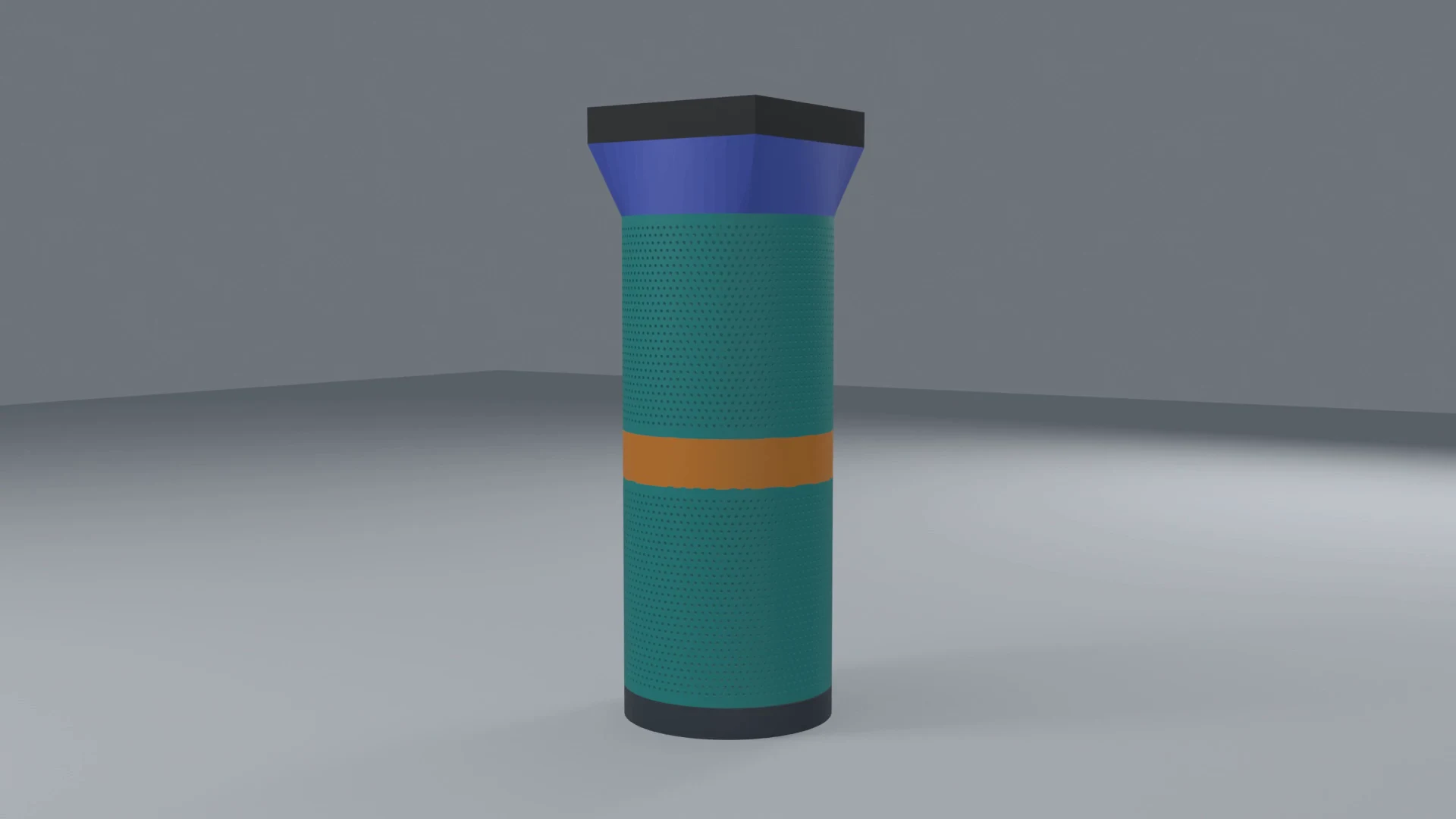
There are four kinds of printed part: a base, a charcoal cartridge, a coupler and a lid that holds a 140 mm fan. Cartridges stack, with a coupler joining one to the next, so the filter can be made taller if it needs more charcoal. With two cartridges it is 150 mm across and 430 mm tall. Every part fits on a 200 mm print bed.
Everything that is not printed is an off-the-shelf part. The fan is a standard 140 mm PC case fan, which is why the lid is the size it is. These fans are cheap, quiet, sold everywhere and easy to replace when one fails. The lid has pilot holes for ordinary self-tapping fan screws, so nothing needs gluing.
This is revision 13 as a 45-second walkthrough. It has no sound.
Where it stands
Nothing has been printed yet. The design is done, the STL files are exported and I have the charcoal. The next step is to print the thread test pieces and see whether they fit, then the full-size parts.
Thirteen revisions with nothing printed sounds like a lot, but changing a design on screen costs nothing, and a failed print costs hours and plastic. I will update this post when the filter is built.
References
- Azimi P, Zhao D, Pouzet C, Crain NE, Stephens B (2016). Emissions of ultrafine particles and volatile organic compounds from commercially available desktop three-dimensional printers with multiple filaments. Environmental Science & Technology 50(3), 1260–1268. doi:10.1021/acs.est.5b04983
- Zhang Q, Pardo M, Rudich Y, Kaplan-Ashiri I, Wong JPS, Davis AY, Black MS, Weber RJ (2019). Chemical composition and toxicity of particles emitted from a consumer-level 3D printer using various materials. Environmental Science & Technology 53(20), 12054–12061. doi:10.1021/acs.est.9b04168